Why Dealers Announce an Action Before It Moves
Why dealers announce an action: clear calls help players follow each table move, reduce confusion and keep the game’s shared rhythm without predicting outcomes.
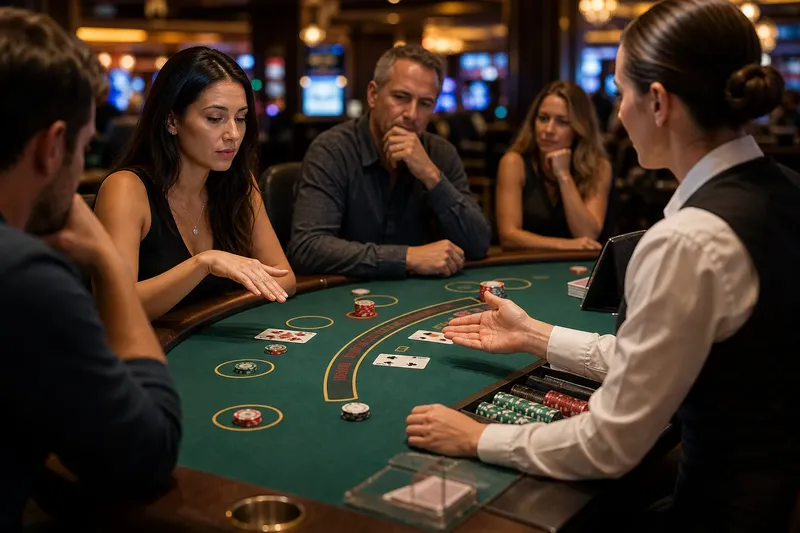
At a blackjack table, a player pauses with a hand hovering above the felt while the dealer waits. Why dealers announce an action becomes clear in moments like this: a spoken call can help everyone follow what is happening, rather than infer a choice from an uncertain gesture.
Those words do not hint at the next card or steer chance. They mark a decision or action so the player, dealer and others nearby can keep track of the game’s sequence. The precise wording and procedure can vary by venue and table, so the scene below is an invented illustration, not a claim about a universal rule.
An uncertain gesture can leave the table waiting
Imagine a hypothetical blackjack game at a busy casino table. Mara has received two cards. She looks at them, glances towards the dealer and hovers her fingers over the felt without touching her chips.
Other players are waiting, and the dealer needs to know whether Mara is asking a question, considering a move or simply adjusting her position. In this invented situation, the dealer pauses and asks, “Would you like another card, or would you like to stand?” That wording is illustrative; another table may use different language or a different process.
Mara says she would like to stand. In this imagined exchange, the dealer repeats the choice and proceeds in keeping with the table’s procedure. The observable result is that Mara and the people nearby can hear which decision was understood, rather than having to guess from her earlier movement.
A spoken call makes the sequence easier to follow
A dealer’s announcement can work like a bicycle’s turn signal: it communicates an intended movement without deciding what happens next. At a table, a brief call can identify an action, make it audible to people watching from different angles and help distinguish a decision from an incidental gesture.
That shared cue is useful in a room where players may be learning, chatting quietly or watching more than one hand. It gives the group a simple sequence to follow: a player acts, the action is recognised, and the game continues according to its rules.
Calls also help organise attention. A dealer can name the action being handled rather than relying only on quick movements, while players can listen for what is happening now. The announcement does not settle the game’s outcome.
A call marks an action, not a prediction
In the imagined round, Mara’s decision is acknowledged before play moves on. The cards and applicable game rules determine what follows; the dealer’s words do not forecast a result or change the chance involved.
A tense moment can make a clear call feel loaded with meaning. It is still a description or confirmation of the current action, not a signal that the next card will favour one player. Listening to the words can help a newcomer understand the present turn without trying to interpret every movement at once.
What should you know about dealer calls?
Why might a dealer repeat a player’s decision?
Repeating a choice can make it audible and confirm what the dealer understood. The exact practice depends on the game and venue.
Can a spoken call affect the cards?
No. A call communicates an action; it does not predict or alter the cards. The outcome follows the game’s rules and chance.
What can you do if a call is unclear?
Pause and ask the dealer to clarify before acting. A plain question gives the dealer a chance to explain the local procedure.
Are calls and gestures the same at every table?
No. Wording and procedures can differ between games and venues. Follow the dealer’s explanation and the table’s posted rules if a familiar gesture is treated differently.
Listen for the action being recognised
In the invented scene, Mara’s spoken choice gives the dealer something clear to acknowledge, while the other players can follow when attention moves on. That is the practical purpose of why dealers announce an action: a call helps people share the sequence, not anticipate the result.
If you are watching a table, match the announcement to the action that follows. If you are playing and are unsure what a gesture means at that venue, pause and ask before acting. That small check can prevent a misunderstanding while leaving chance where it belongs: in the outcome of the game.